
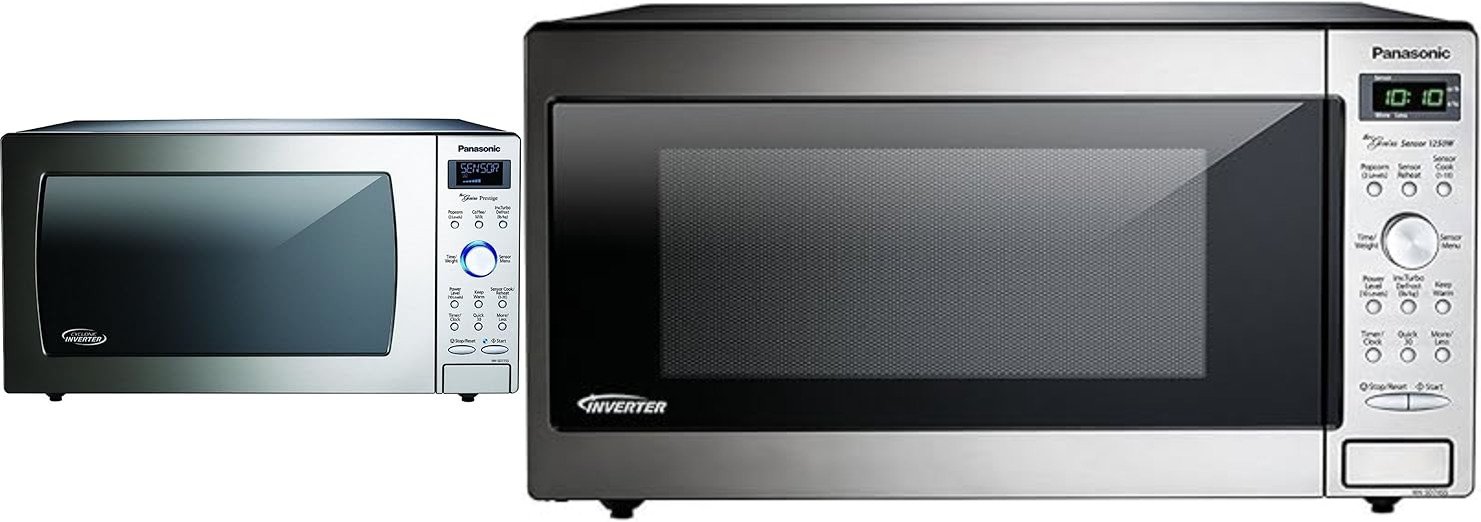
If you’re shopping for a high-end microwave oven and considering the two excellent models from Panasonic — namely the NN-SD775S and the NN-SD745S — it’s important to understand their strengths, how they compare, and especially the **main difference** between them. In this article we’ll dive into the features, performance, specifications, and help you decide which one may be the better fit for your kitchen needs.
The Main Difference: What sets the NN-SD775S and NN-SD745S apart?
At a high level, both models are part of Panasonic’s “inverter” microwave line: large-capacity (1.6 cu ft), high-power (1250W) units that use advanced cooking technologies for more even heating and better performance over traditional microwaves. That means they share many core features. However, the **key differentiator** between them comes down to refined enhancements and features in the NN-SD775S (for example newer “Cyclonic Wave” technology) compared to the NN-SD745S. In short: the NN-SD775S represents a step-up (or newer generation) with improved wave/circulation technology and expanded menu presets, whereas the NN-SD745S delivers much of the same core inverter performance at perhaps slightly lower cost or older generation. Understanding this main difference helps you weigh whether the extra features are worth the premium (if any) or whether the slightly simpler model already covers your needs.
Feature Overview: Panasonic NN-SD775S
The Panasonic NN-SD775S is a 1.6 cu ft (about 45 litres) countertop or built-in capable microwave with 1250 watts of cooking power. It features the “Cyclonic Wave” Inverter Technology which claims to “evenly circulate heat in 3D waves for more even, efficient cooking”. :contentReference[oaicite:1]{index=1}
Key Highlights include:
- Capacity: 1.6 cu ft (≈45 L) :contentReference[oaicite:2]{index=2}
- Cooking Power: 1250 W. :contentReference[oaicite:3]{index=3}
- Inverter Technology: Delivers a continuous stream of power rather than cycling, which helps with more consistent cooking and thawing. :contentReference[oaicite:4]{index=4}
- Cyclonic Wave: The patented wave‐circulation claims to improve uniformity (edges to centre) and preserve texture and nutrients. :contentReference[oaicite:5]{index=5}
- Sensor Cook / Sensor Reheat: Built-in sensors that detect steam or cooking environment to automatically adjust time/power. :contentReference[oaicite:6]{index=6}
- Size / Dimensions: According to Panasonic’s spec sheet, width 16 7/16″ (418 mm), height 9″ (228 mm) for interior; exterior width 21 7/8″ (555 mm), height 11 15/16″ (304 mm), depth 19 7/16″ (493 mm). :contentReference[oaicite:7]{index=7}
- Additional features: Quick 30 second button, multiple stage cooking, child lock, keep warm, etc. :contentReference[oaicite:8]{index=8}
In practice, this means the NN-SD775S is designed not just to reheat, but handle more delicate cooking tasks—such as melting butter, simmering fish, warming evenly, thanks to the inverter + cyclonic wave combo. One review of the inverter line noted: “When we used the microwave to make hollandaise sauce, melt chocolate and even pulled pork … the Panasonic inverter microwave did very well.” :contentReference[oaicite:9]{index=9}
Feature Overview: Panasonic NN-SD745S
The Panasonic NN-SD745S is the “older sibling” or earlier generation in the same family: also 1.6 cu ft capacity, 1250 W cooking power, Inverter Technology and sensor cooking features. :contentReference[oaicite:10]{index=10}
Key Highlights include:
- Capacity: 1.6 cu ft (≈45 L) :contentReference[oaicite:11]{index=11}
- Cooking Power: 1250 W. :contentReference[oaicite:12]{index=12}
- Inverter Technology: Yes — giving more even heating and better performance than many standard microwaves. :contentReference[oaicite:13]{index=13}
- Sensor Cook / Sensor Reheat: Included. :contentReference[oaicite:14]{index=14}
- Dimensions: Similar to above for 1.6 cu ft models: width 16 7/16″ (418 mm), etc. :contentReference[oaicite:15]{index=15}
- Control interface: Some reviews mention it uses a dial + button interface rather than full touchscreen or newer interface. :contentReference[oaicite:16]{index=16}
In essence, the NN-SD745S gives you nearly the same core cooking power and inverter benefits as the newer model, but it may lack some of the “Cyclonic Wave” branding or latest refinements, and may have a different interface or fewer menu presets. It has been reviewed favourably — TechGearLab called it “one of the best, largely in part due to its superb heating score.” :contentReference[oaicite:17]{index=17}
Side-by-Side Comparison Table
Here’s a comparison table in HTML format designed to fit on mobile and desktop without breaking the page layout:
| Specification | NN-SD775S | NN-SD745S |
|---|---|---|
| Capacity | 1.6 cu ft (≈45 L) | 1.6 cu ft (≈45 L) |
| Cooking Power | 1250 W | 1250 W |
| Inverter Technology | Yes (Cyclonic Wave + Inverter) | Yes (Inverter) |
| Advanced Wave/Circulation Tech | Cyclonic Wave for 3D heat circulation | Standard wave circulation |
| Sensor/Reheat/Defrost | Yes (Genius Sensor, Turbo Defrost) | Yes (Sensor Cook/Reheat) |
| Interface / Controls | Likely newer interface & presets | Dial + Button interface (older) :contentReference[oaicite:18]{index=18} |
| Dimensions (External approx.) | ≈21.9″ W × 11.94″ H × 19.94″ D (≈555×304×506 mm) :contentReference[oaicite:19]{index=19} | Same approx dimensions: width 21.9″, height 11.94″ (≈304 mm) :contentReference[oaicite:20]{index=20} |
| Best suited for | Users wanting top‐tier even cooking/uniformity and extra wave tech | Users wanting high power/inverter benefits with overhead cost savings |


Which One Should You Choose?
When deciding between the NN-SD775S and the NN-SD745S, ask yourself the following questions:
- Do you frequently do more than just reheating leftovers and popcorn — for example, melting chocolate, simmering delicate foods, using the microwave like a mini oven? If yes, the NN-SD775S’s “Cyclonic Wave” tech likely gives you a tangible benefit.
- Is the budget or price difference significant for you? If you find the NN-SD745S at a better price and you’ll mostly use it for reheating, defrosting, everyday cooking, then it may provide excellent value with nearly all the core benefits.
- Do you care about interface/presets? If you like faster access to more one‐touch presets, newer interface, perhaps the NN-SD775S will be more convenient.
- Installation/space: Both models share nearly identical physical size and capacity, so you likely won’t need extra space or modifications if you swap between them. Just ensure your counter/built‐in space accommodates the external dimensions (~21.9” wide, ~12” high, ~20” deep) and remember built-in trim kit compatibility if required. :contentReference[oaicite:21]{index=21}
Considerations & Practical Tips
Here are some additional practical tips to help you get the best from whichever model you choose:
- Ensure correct voltage/plug type for your location. These models are specified for 120 V/60 Hz in the USA market. If you are purchasing or shipping to Pakistan (Sargodha, Punjab, etc), verify local voltage/frequency and shipping/import issues.
- Ventilation and clearance: Especially if installing as a built-in unit rather than countertop, ensure proper clearance for heat dissipation. Panasonic’s specification site lists installation steps. :contentReference[oaicite:22]{index=22}
- Turntable size matters: Both models support large dishes; for example a 380 mm (≈15”) turntable diameter is listed for similar models. :contentReference[oaicite:23]{index=23}
- Sensor cooking advantage: The sensor cook and reheating functions are particularly beneficial if you reheat a variety of food types frequently — they remove much of the guesswork of time/power settings.
- Evenness of cooking: According to review data, the SD745S had excellent heating uniformity in tests (variation ~1.9°F in one test) though somewhat less perfect in some workloads. :contentReference[oaicite:24]{index=24}
- Price vs feature balance: If there is a small premium for the newer model, you must determine whether the extra uniformity/circulation tech is worth it for your use-case.
Summary
In summary, the **main difference** between the Panasonic NN-SD775S and the Panasonic NN-SD745S is the added circulation/wave technology (Cyclonic Wave) and possibly refined interface/presets present in the NN-SD775S, whereas both models share the same capacity (1.6 cu ft), same cooking power (1250 W), and core inverter/sensor cooking platform. If you want the very best uniformity and are prepared to invest a little more, go for the NN-SD775S. If you’re cost-sensitive and still want top-tier inverter microwave performance for everyday cooking and reheating, the NN-SD745S offers tremendous value.
Choose according to how you use your microwave, your budget, and how much the extra refinements matter to you. Either way, you’ll be getting a powerful, high-quality inverter microwave that outperforms many conventional models.
Leave a Comment