
Ninja TB401 vs BN801
Ninja TB401
BlendSense sensor tech, 1800 peak watts, and a feed-chute processor bowl for hands-off consistency.
Ninja BN801
Five Auto-iQ presets, a 1400-peak-watt motor, and two 24-oz cups at a friendlier price point.
The main difference between the Ninja TB401 and BN801 comes down to how each machine decides what to do with your ingredients. The TB401 uses BlendSense, a sensor system that reads what's in the pitcher and automatically adjusts speed, time, and pulses on its own, backed by an 1800-peak-watt motor. The BN801 instead relies on Auto-iQ, five fixed one-touch programs, running on a 1400-peak-watt motor.
Both are true kitchen systems rather than plain blenders — each pairs a full-size pitcher with a food processor bowl and single-serve cups, so you can go from a smoothie to salsa to cookie dough without pulling out a second appliance. Where they part ways is in automation, raw power, and a few small hardware details that matter more than they first appear.
Below, we break down the specs, the smart technology, real-world batch performance, and exactly which shopper each model is built for, so you can pick the one that actually earns a permanent spot on your counter.
Check current prices

Overview
Model Overview
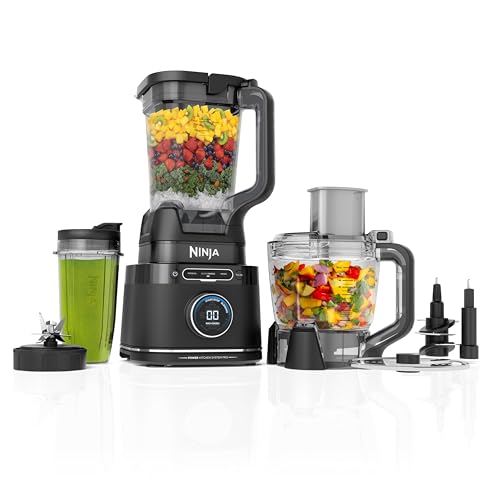
Ninja Kitchen System with BlendSense
The newer of the two systems. A 72-oz pitcher and 8-cup (roughly 64-oz) food processor bowl pair with an 1800-peak-watt motor base, and BlendSense automatically adjusts for fresh versus frozen ingredients, portion size, and liquid level. A single dial replaces separate buttons, and the system ships in black.
Ninja Professional Plus Kitchen System with Auto-iQ
The established option. A 72-oz Total Crushing pitcher and 64-oz food processor bowl pair with a 1400-peak-watt motor, controlled through 9 manual speeds plus five Auto-iQ presets for smoothies, frozen drinks, extractions, chopped mixtures, and dough. It includes two 24-oz cups instead of one.
Side by Side
Full Specs Table
| Spec | Ninja TB401 | Ninja BN801 |
|---|---|---|
| Smart technology | BlendSense (Torque, Portion & Liquid Detect) | Auto-iQ (5 preset programs) |
| Peak wattage | 1800 peak watts | 1400 peak watts |
| Control interface | Single smart dial | Digital display + 9 speeds |
| Blender pitcher | 72-oz Total Crushing & Chopping pitcher | 72-oz Total Crushing pitcher |
| Max liquid capacity | ~64 oz | 64 oz |
| Food processor bowl | 8-cup / ~64-oz with feed chute | 8-cup / 64-oz with feed chute |
| Processor dough capacity | Up to 2 lbs | Up to 2 lbs |
| Single-serve cups | (1) 24-oz to-go cup | (2) 24-oz Nutri Ninja cups |
| Blade assemblies | Total Crushing blade, processor blade, dough blade | Total Crushing blade, Pro Extractor blade, processor & dough blades |
| Preset programs | Sensor-driven, auto-adjusting | 5 fixed Auto-iQ presets |
| Color options | Black | Black/stainless, grey |
| Auto shut-off | Yes | Yes |
| Locking lid safety | Yes | Yes |
| Dishwasher-safe parts | Yes | Yes |
| Best for | Hands-off, sensor-adjusted blending | Budget-minded multi-function prep |
See today's pricing
Under The Hood
Smart Technology: BlendSense vs Auto-iQ
Auto-iQ, the system in the BN801, works from five preset programs. Pick "smoothie" or "dough" and the machine runs a pre-programmed sequence of pulses and speeds designed for that task. It's consistent and easy to learn, but it doesn't know whether your bananas are fresh or frozen solid — you're still the one deciding how much ice to add.
BlendSense, in the TB401, goes a step further. Torque Detect senses whether the load is fresh or frozen and adjusts power accordingly, Portion Detect factors in how much you've loaded into the pitcher, and Liquid Detect flags when a blend needs more liquid to move properly. In practice, that means less guessing about settings and fewer under-blended pockets at the bottom of the pitcher.
Neither approach is objectively "wrong." Auto-iQ is simpler to understand at a glance, while BlendSense trades a slightly steeper learning curve for more consistent results across a wider range of ingredients.
Room To Cook
Capacity & Batch Size
Both systems are built around a 72-oz pitcher, so family-size smoothie batches and frozen drink rounds land in the same territory. The food processor bowls are similarly matched at roughly 8 cups, enough for a full batch of cookie dough or a large bowl of salsa without needing to work in stages.
The real difference shows up in the cups. The BN801's two 24-oz cups mean two people can blend single servings back-to-back without washing a cup in between — a small thing that matters in a busy kitchen. The TB401 ships with one, though additional cups are sold separately.
Look & Feel
Design & Build Quality
The BN801 has the more traditional Ninja look: a digital display, physical speed dial, and the familiar black-and-stainless or grey finish that's been in Ninja's lineup for years. The TB401 simplifies the control panel down to a single dial that indicates the active mode, giving it a cleaner, more minimal face on the counter.
Both use the same general base-and-pitcher locking mechanism, dishwasher-safe components, and a comparable footprint, so neither will dramatically change how much counter or cabinet space you need to set aside.
In The Kitchen
Real-World Performance
With 400 more peak watts on tap, the TB401 tends to power through ice and frozen fruit a touch faster, and BlendSense's auto-adjustment helps it settle on a smooth consistency without babysitting the dial. The BN801 isn't underpowered by any means — 1400 peak watts comfortably handles everyday smoothies, frozen drinks, and chopping — it simply asks you to pick the right preset or speed yourself.
For dough and processor tasks, the two perform very similarly, since bowl size and blade design are closely matched. The gap is most noticeable with dense, ice-heavy blends, where the TB401's extra wattage and sensing give it a slight edge in consistency.
Match It To Your Routine
Best Use Cases
Daily Smoothies
Both handle a morning smoothie routine well; the TB401 needs less trial and error to get it smooth.
Frozen Drinks
Higher peak wattage gives the TB401 an edge with heavily iced blends and frozen cocktails.
Cookie Dough
Matched processor bowls mean both mix a full batch of dough without a second round.
Salsa & Chopping
The 8-cup processor bowl on either model handles chunky or fine salsa with a few pulses.
On-The-Go Cups
Two households sharing one blender lean toward the BN801 for its pair of 24-oz cups.
Budget-First Kitchens
The BN801 covers the same core functions at a lower typical price point.
Weigh It Up
Pros & Cons
Ninja TB401 — Pros
- 1800 peak watts for tougher, ice-heavy blends
- BlendSense auto-adjusts speed and time
- Simplified single-dial control
- Feed-chute processor bowl for hands-off prep
Ninja TB401 — Cons
- Ships with only one 24-oz cup
- Only available in black
- Typically priced higher than the BN801
Ninja BN801 — Pros
- Five Auto-iQ presets take the guesswork out
- Two 24-oz cups included
- Widely available and usually lower priced
- Digital display and 9-speed manual control
Ninja BN801 — Cons
- Lower 1400-peak-watt motor
- No ingredient-sensing automation
- Older control design compared to the TB401
Bottom Line
Final Verdict
Choose the Ninja TB401 if you want the most current technology on the counter — more peak power and BlendSense's automatic adjustments make it the easier machine to get consistently smooth results from, with less attention to settings.
Choose the Ninja BN801 if you want the same core functions — blending, processing, dough, single-serve cups — at a friendlier price, and you don't mind picking your own preset instead of letting sensors decide.
Ready To Pick One?
Both systems replace a blender, a food processor, and a set of to-go cups with one base. Check today's pricing before deciding.
Quick Decision
Which Should You Buy?
| If you want… | Buy this |
|---|---|
| Maximum peak power and auto-adjusting blends | Ninja TB401 |
| The lowest price with core functions covered | Ninja BN801 |
| Two cups included for a two-person household | Ninja BN801 |
| The simplest, most hands-off control | Ninja TB401 |
Common Questions
FAQ
What is the main difference between the Ninja TB401 and BN801?
The main difference between the Ninja TB401 and BN801 is the technology and motor power: the TB401 uses BlendSense sensing with 1800 peak watts, while the BN801 uses fixed Auto-iQ presets with 1400 peak watts.
Is the Ninja TB401 more powerful than the BN801?
Yes — 1800 peak watts on the TB401 versus 1400 peak watts on the BN801, which gives the TB401 more headroom with ice and frozen fruit.
Does the BN801 have Auto-iQ or BlendSense?
The BN801 uses Auto-iQ, Ninja's five-program preset system. BlendSense is exclusive to newer models like the TB401.
How many cups come with each system?
The TB401 includes one 24-oz cup; the BN801 includes two 24-oz cups.
Are the food processor bowls the same size?
Both use an 8-cup, roughly 64-oz bowl that handles up to about 2 lbs of dough or a full batch of salsa.
Which is better for smoothies?
Both blend smoothies well; the TB401's extra wattage and auto-sensing tend to produce more consistent results with less manual adjustment.
Does the TB401 replace the BN801?
Not officially — the BN801 remains available as a lower-priced option, while the TB401 sits above it with newer technology.
Is the BN801 a good budget alternative?
Yes, it covers the same core blending, chopping, and dough functions at a typically lower price than the TB401.
Leave a Comment