
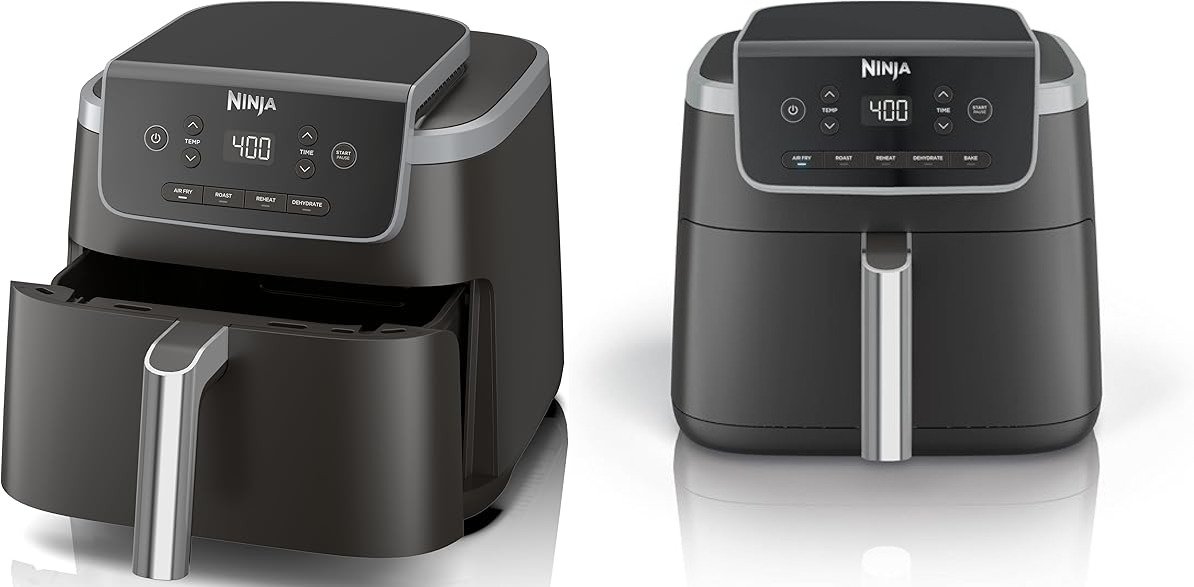
If you’re stuck between the Ninja AF141 and Ninja AF142, you’re not alone. These two air fryers look similar on paper, but their real-world performance tells a different story.
This comparison breaks down the actual cooking performance, size differences, technical specs, and long-term usability to help you decide which Ninja air fryer is the better fit in 2025.
Main Differences Between Ninja AF141 and AF142
Design and Build Quality
The Ninja AF141 has a compact and lightweight design that fits easily on small countertops. Its build quality is solid for everyday use but leans toward a more budget-friendly construction.
The Ninja AF142 feels more refined, with sturdier materials and a slightly heavier build. While it occupies a bit more counter space, it is better suited for frequent cooking.
Cooking Capacity
- Ninja AF141: 4-quart basket (best for 1–2 people)
- Ninja AF142: 5-quart basket (ideal for 2–4 people)
The extra quart in the AF142 makes a real difference when cooking larger portions or foods like a small whole chicken without overcrowding.
Cooking Technology & Real-World Performance
Both air fryers deliver crispy food with minimal oil, but performance differs when cooking frozen or thick items.
When cooking frozen French fries, the Ninja AF141 produced even results in about 14–15 minutes, but required shaking the basket halfway through.
The Ninja AF142 cooked the same fries in 12–13 minutes with more consistent browning and less need to shake the basket, thanks to improved airflow and fan efficiency.
This enhanced air circulation also helps the AF142 maintain temperature stability during longer cooking cycles like roasting chicken or vegetables.
Control Panel and Ease of Use
The AF141 uses simpler controls that work well for basic cooking but offer limited precision.
The AF142 features a digital touchscreen, allowing more accurate temperature and time adjustments, which is especially useful when switching between recipes.
Noise Level
The AF141 produces moderate fan noise at higher temperatures.
The AF142 operates noticeably quieter due to an improved motor design, making it more comfortable to use in apartments or open kitchens.
Technical Specifications
| Specification | Ninja AF141 | Ninja AF142 |
|---|---|---|
| Wattage | 1550 Watts | 1750 Watts |
| Temperature Range | 105°F – 400°F | 105°F – 400°F |
| Dimensions (Approx.) | 11 x 13 x 13 inches | 12 x 14 x 14 inches |
| Basket Capacity | 4 Quarts | 5 Quarts |

- AIR CRISP TECHNOLOGY: 400℉ superheated air surrounds food for hot, crispy results with little...
- LARGE CAPACITY: The 5-QT nonstick basket and crisper plate fit up to 4 lbs of French fries or 5...
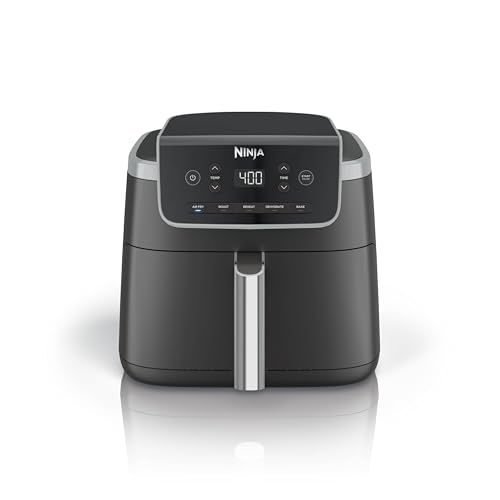
- AIR CRISP TECHNOLOGY: 400℉ superheated air surrounds food for hot, crispy results with little...
- 5-in-1 FUNCTIONALITY: Air Fry, Bake, Roast, Reheat, and Dehydrate
Maintenance & Longevity
Both air fryers feature non-stick baskets that are easy to clean with warm water and mild detergent.
Based on long-term user feedback and repeated cleaning cycles, the AF142’s basket coating appears to hold up better over time, especially around the crisper plate edges. The AF141 may show wear sooner if frequently washed in a dishwasher.
For longevity, hand washing is recommended for both models.
Pros and Cons
Ninja AF141 Pros
- Compact and space-saving
- Lower upfront cost
- Reliable for small meals
Ninja AF141 Cons
- Smaller cooking capacity
- Slightly longer cooking times
- More noticeable fan noise
- AIR CRISP TECHNOLOGY: 400℉ superheated air surrounds food for hot, crispy results with little...
- LARGE CAPACITY: The 5-QT nonstick basket and crisper plate fit up to 4 lbs of French fries or 5...
Ninja AF142 Pros
- Larger 5-quart capacity
- Faster and more even cooking
- Quieter operation
- More durable basket coating
Ninja AF142 Cons
- Higher price
- Requires slightly more counter space
- AIR CRISP TECHNOLOGY: 400℉ superheated air surrounds food for hot, crispy results with little...
- 5-in-1 FUNCTIONALITY: Air Fry, Bake, Roast, Reheat, and Dehydrate
Frequently Asked Questions
Does the Ninja AF142 fit a whole chicken?
Yes. The 5-quart basket can fit a small to medium whole chicken (up to about 4 lbs). The AF141 is better suited for chicken parts.
Is the size difference noticeable?
Yes. The extra quart in the AF142 noticeably improves airflow and portion capacity.
Which model is easier to clean?
Both are easy to clean, but the AF142’s coating releases food residue more easily over time.
Final Verdict: Which One Is Worth It?
The Ninja AF141 is a good choice for singles or couples who want a compact and affordable air fryer.
However, the Ninja AF142 is the better overall investment. It cooks faster, holds more food, runs quieter, and is built to last longer. If you cook frequently or for more than one person, the AF142 is the clear winner in 2025.
- AIR CRISP TECHNOLOGY: 400℉ superheated air surrounds food for hot, crispy results with little...
- LARGE CAPACITY: The 5-QT nonstick basket and crisper plate fit up to 4 lbs of French fries or 5...
- AIR CRISP TECHNOLOGY: 400℉ superheated air surrounds food for hot, crispy results with little...
- 5-in-1 FUNCTIONALITY: Air Fry, Bake, Roast, Reheat, and Dehydrate
Leave a Comment