
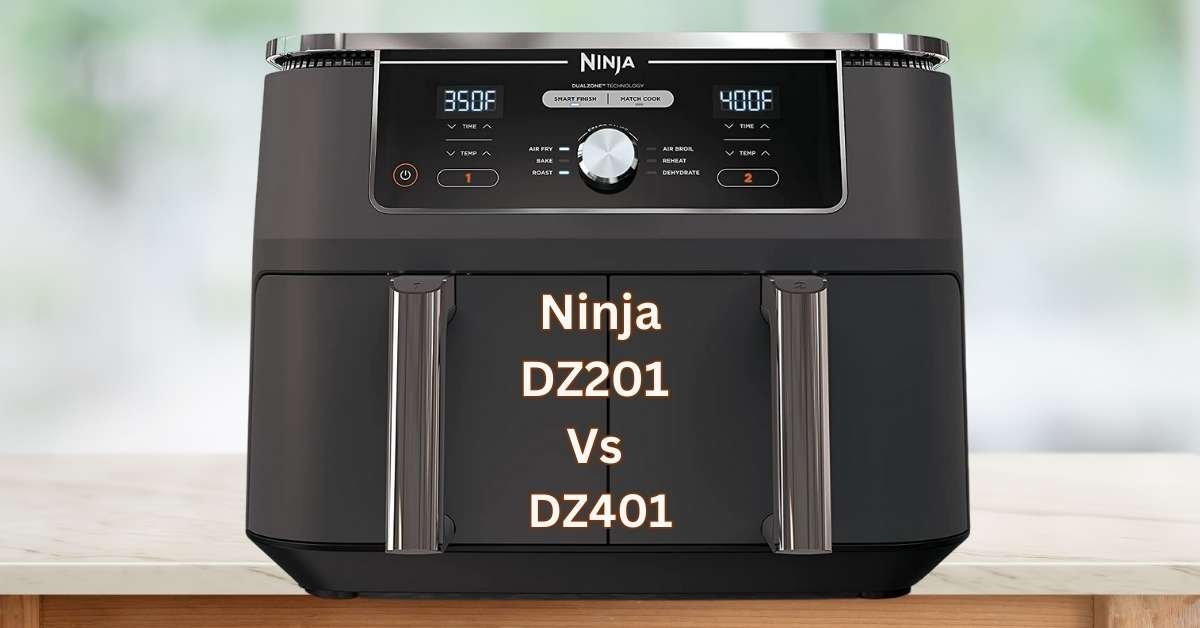
Hello, kitchen warriors! Chef Roberto here. If you cook more than one dish at a time—or wish you could—Ninja’s DualZone air fryers are hard to ignore. I’ve spent real time cooking with both the Ninja Foodi DZ201 (8-Qt) and the Ninja Foodi XL DZ401 (10-Qt), and while they share the same core technology, they do not feel the same in daily use.
Capacity and How It Changes Meal Planning
The main difference between the Ninja DZ201 and Ninja DZ401 is total usable basket volume, and that difference directly changes how you plan meals. The DZ201 uses two 4-quart baskets, while the DZ401 steps up to two 5-quart baskets. That extra quart per zone doesn’t sound dramatic, but in practice it’s the difference between “this fits comfortably” and “this is packed tight.”
For example, both can roast chicken—but while the DZ401 can handle a whole chicken close to 5 pounds, airflow is much better with a 4–4.5 lb bird. In the DZ201, a whole chicken is possible, but it’s not something I’d recommend doing often.
Comparison Table: Ninja DZ201 vs DZ401 Air Fryers
| Feature | Ninja DZ201 (8-Qt) | Ninja DZ401 (10-Qt) |
|---|---|---|
| Best For | Couples, small families, limited counter space | Families, meal prep, full meals |
| Total Capacity | 8 Quarts (2 × 4-Qt) | 10 Quarts (2 × 5-Qt) |
| Temperature Range | 105°F – 450°F | 105°F – 450°F |
| Cooking Functions | 6-in-1 | 6-in-1 |
| Interface | Digital Buttons | Digital Display + Selection Dial |
| Wattage | 1690 Watts | 1690 Watts |
| Weight | ~17.8 lbs | ~19.8 lbs |
| Dimensions | 15.6″ L × 13.9″ W × 12.4″ H | 17.1″ L × 13.9″ W × 12.8″ H |
| Cord Length | Approx. 2.6 ft | Approx. 2.6 ft |
| Basket Coating | Ceramic, PTFE/PFOA-Free | Ceramic, PTFE/PFOA-Free |

Counter Space and Kitchen Fit
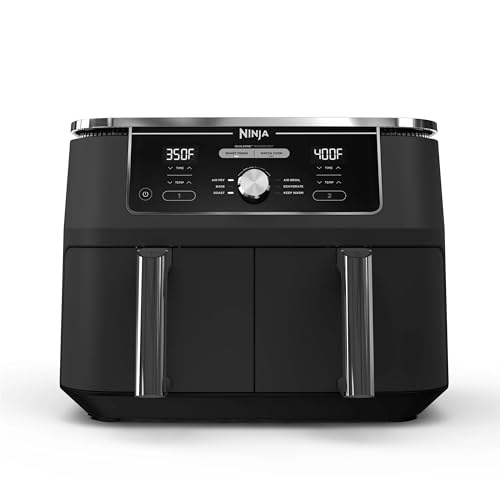
The main difference between the DZ201 and DZ401 on the counter is width. Both are deep machines, but the DZ401 is noticeably wider. In small kitchens or apartments, that extra inch and a half can be the difference between leaving it out or storing it away.
If you cook daily and have the space, the DZ401 earns its footprint by reducing batch cooking. If you cook a few times a week, the DZ201 feels more manageable.
Cooking Functions Explained (And Corrected)
The main difference between the Ninja DZ201 and DZ401 is not cooking power—both reach 450°F—but how comfortably they handle high-heat cooking. Both are true 6-in-1 machines with the same core modes:
- Air Fry
- Air Roast
- Air Broil
- Bake
- Reheat
- Dehydrate
Where the DZ401 pulls ahead is broiling efficiency. The XL baskets offer more vertical space, and the included broil rack lifts food closer to the heating element. The DZ201 can broil too, but it relies more on the crisper plate and tighter spacing.
Interface and Ease of Use (A Real Difference)
The main difference between the DZ201 and DZ401 controls is speed. The DZ201 uses a fully digital button interface. It’s precise but requires multiple presses when switching modes or zones.
The DZ401 adds a central selection dial. In daily cooking, that dial is faster. Turning instead of tapping sounds small, but when you’re adjusting two baskets with different foods, it genuinely improves the experience.
Smart Finish & Match Cook in Real Cooking
The main difference between these two models is not the technology—it’s how much food you can synchronize.
Here’s a real example from my kitchen: I set salmon at 375°F for 12 minutes in Zone 1 and thick-cut fries at 400°F for 22 minutes in Zone 2. I press Smart Finish, and Ninja automatically holds the salmon so both zones finish at the same time. That works identically on both models.
The advantage of the DZ401 is scale. You can do this with full family portions instead of smaller batches.
Noise, Build Quality, and Long-Term Durability
The main difference between the DZ201 and DZ401 here is weight. The DZ401 is about 2 pounds heavier, which helps stability when both baskets are loaded.
Noise levels are similar. Running both zones at 450°F creates a steady fan hum, but nothing disruptive. The ceramic coating holds up well, but like all nonstick surfaces, gentle cleaning extends its life.
Ninja DZ201 Pros and Cons
- Pro: Same 450°F power as the XL model
- Pro: Smaller footprint fits compact kitchens
- Pro: Easier to store when not in use
- Con: Smaller baskets limit large proteins
- Con: Button interface is slower to navigate
Ninja DZ401 Pros and Cons
- Pro: Larger baskets reduce batch cooking
- Pro: Dial control is faster and more intuitive
- Pro: Better airflow for broiling and crisping
- Con: Takes more counter space
- Con: Heavier and less portable
Who Should Choose Which Model
Ninja DZ201 Foodi 8-Qt: Ideal for couples, small families, apartment kitchens, and anyone who wants DualZone cooking without giving up counter space.
Ninja DZ401 Foodi XL 10-Qt: Best for families, meal preppers, and anyone who regularly cooks full meals in one cycle.
Final Thoughts
Both the Ninja DZ201 and DZ401 deliver the same cooking technology and temperature range. The choice isn’t about power—it’s about space, scale, and usability.
If you want compact efficiency, the DZ201 is the smarter buy. If you want fewer batches, easier controls, and room to cook real family portions, the DZ401 earns its spot on the counter.
Leave a Comment