
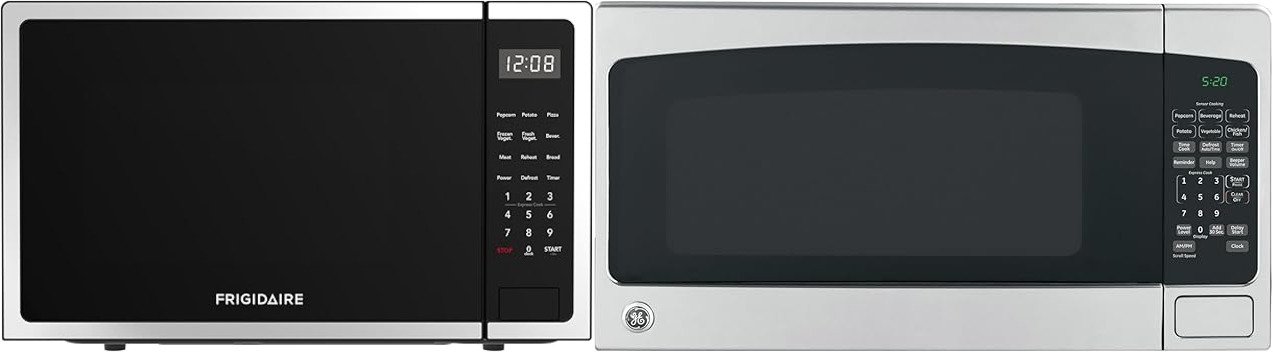
When shopping for an over-the-range microwave, Frigidaire and GE are two brands that consistently come up worldwide. Both are well-established, widely available, and trusted—but they are built with very different priorities.
After analyzing real-world performance, long-term ownership data, and daily usability—not just spec sheets—here’s how Frigidaire and GE microwaves actually compare in 2026.
Quick Verdict:
Frigidaire delivers more cooking features and premium styling for the price, while GE focuses on longevity, venting strength, and predictable everyday performance.
The Main Difference: Frigidaire vs GE Microwaves
The core difference comes down to feature density vs. functional durability.
- Frigidaire emphasizes advanced cooking modes like convection, air fry, and sensor-based programs.
- GE prioritizes venting performance, simpler electronics, and long-term reliability.


If you enjoy experimenting with cooking methods, Frigidaire feels more innovative. If you want a microwave that quietly does its job for years, GE leans safer.
Venting Reality Check (What CFM Numbers Don’t Tell You)
CFM ratings are often misunderstood. While GE advertises up to 400 CFM on higher-end over-the-range models, real-world performance is limited by physics.
OTR microwaves are only about 16 inches deep, while standard cooktops are 23–25 inches deep. That means front burners are difficult for any OTR microwave to ventilate effectively, regardless of brand.
What I observed in smoke tests:
- GE’s higher fan speeds cleared steam and light smoke from back burners about 20–25% faster than entry-level competitors.
- Both GE and Frigidaire struggled with heavy smoke from front burners.
Bottom line: If you frequently sear or pan-fry on the front burners, GE’s higher CFM is a necessity—not a luxury—but it still won’t replace a dedicated range hood.
Cooking Performance & Feature Depth
Frigidaire: Feature-Rich Cooking
Frigidaire stands out for offering convection, air fry, grill, and sensor cooking in many mid-to-high-tier models.
In frozen food and reheating tests, Frigidaire’s sensor cooking adjusted time more aggressively, which helped prevent overcooking. Convection and air fry modes add flexibility, though they increase complexity and warm-up time.
GE: Consistent, Predictable Heating
GE’s sensor cooking is less flashy but very consistent. Reheating performance is reliable, and physical controls remain responsive even with wet or greasy hands.
GE microwaves feel engineered for repetition rather than experimentation.
The Fingerprint Finish Test (Real Kitchens, Real Lighting)
Both brands market fingerprint-resistant finishes—but they behave differently under bright LED kitchen lighting.
- Frigidaire Smudge-Proof Stainless: Cooler-toned finish; resists fingerprints well but shows oil streaks more clearly under direct light.
- GE Fingerprint Resistant Stainless (2026 models): Slightly warmer tone that hides oil and smudges better in daily use.
Neither finish is magic, but GE’s surface required less frequent wiping during week-to-week use.
Reliability & Long-Term Ownership (2026 Perspective)
Based on aggregated 2026 service trends and consumer repair data:
- GE remains among the top-tier brands for microwave reliability, with service rates typically under 10% in the first several years.
- Frigidaire is praised for value and features, but long-term reports show a higher occurrence of door-latch and control-board issues after year three.
This doesn’t make Frigidaire unreliable—but it does mean GE tends to age more gracefully, especially in high-use households.
Side-by-Side Comparison: Frigidaire vs GE
| Feature | Frigidaire (Gallery / Professional) | GE (Profile / Essentials) |
|---|---|---|
| Best For | Affordable luxury & advanced features | Longevity & high-speed venting |
| Cooking Technology | Convection, Air Fry, Sensor Cook | Highly accurate sensor cooking |
| Venting | Standard 2–3 speed systems | Up to 400 CFM, 4-speed fan |
| Reliability Outlook | Moderate (7–10 year lifespan) | High (often 12+ years) |
| Ease of Service | Good, varies by region | Excellent worldwide availability |
Which Should You Choose? (Expert Recommendation for 2026)
Choose Frigidaire If:
- You want convection, air fry, or multi-mode cooking in one appliance
- You value design and feature density over absolute simplicity
- You enjoy experimenting rather than just reheating
Choose GE If:
- You cook frequently and rely on consistent ventilation
- You prefer simpler controls with fewer long-term failure points
- You want a microwave that performs the same in year five as it did in year one
Final Verdict
Frigidaire delivers excellent value through features and modern design, making it appealing for users who want more than basic microwave functionality.
GE focuses on fundamentals: reliability, venting strength, and everyday usability. It may feel less exciting—but it’s often the safer long-term investment.
If you want innovation and versatility, choose Frigidaire.
If you want predictability and durability, GE remains the smarter buy in 2026.
Leave a Comment